Showing posts with label ''new material''. Show all posts

Saturday, 7 July 2012

Stretchable light and the lost of shape


This short demo shows a prototype of a LED that can be stretch. Now, that doesn't sounds like much but think for moment in the sources of light that we have today. Since we tame electricity we've been able to make vessels that contains light. From the light bulb to the pixels that you are looking at right now all our light emitting sources have a discreet shape, its shapes are define by manufacture. Since the commercial introduction of the first light bulbs back in the 1880's the shape have been pretty much the same from the glass balloon to a ''pear'' shape (the German word for light bulb is Glühbirne which can be translated as glowing pear) then to a almost any possible variation of that.
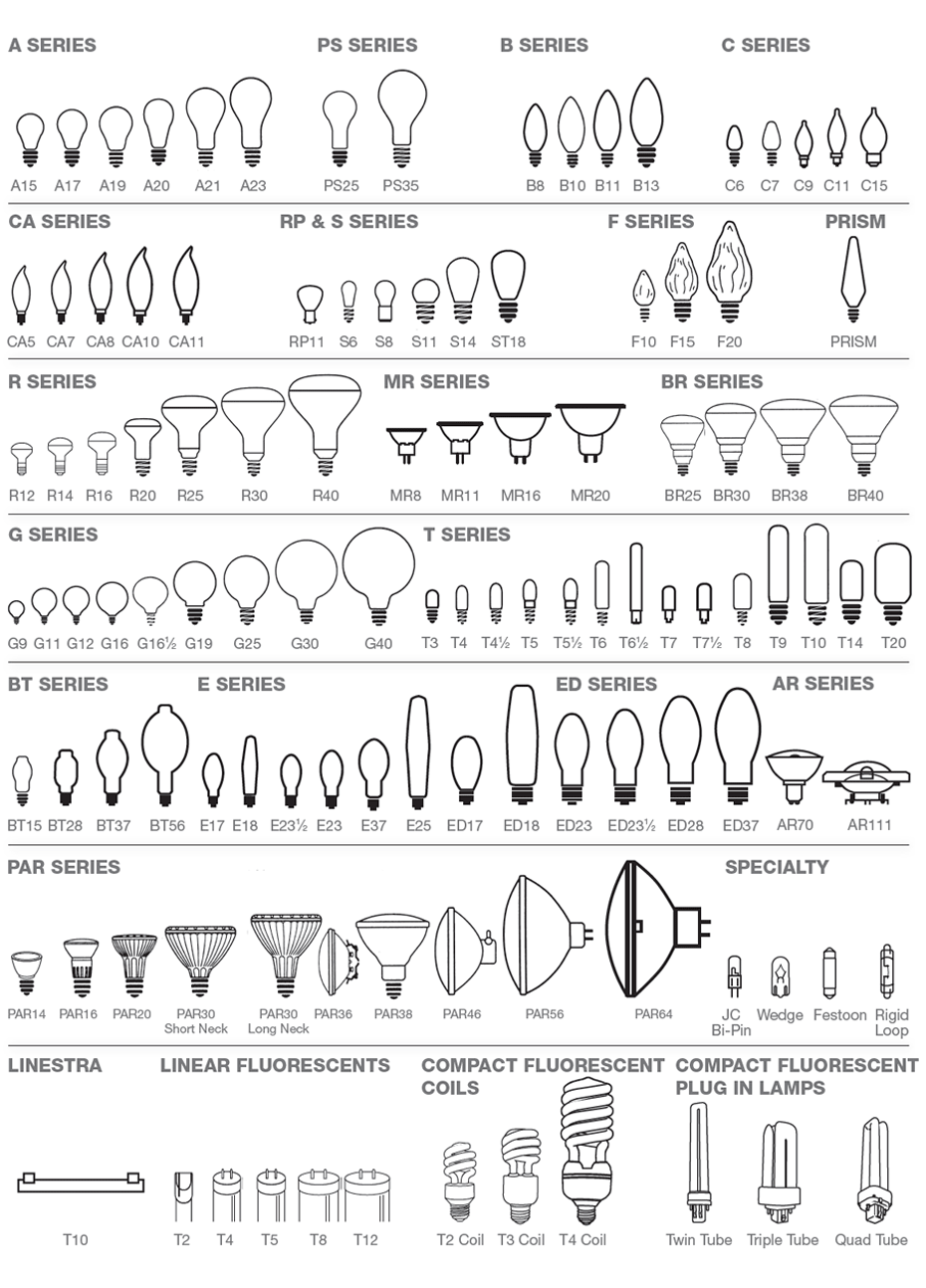
Then the fluorescent (as different as the previous incandescent) lighting technology came and also the halogen and then neon and all of them were confined either to a bulb or a tube. All of them constricted by the formal possibilities of glass. And this kept going up to the introduction in the early 60's of LED (light emitting diodes) which change the electrically powered reaction within an micro atmosphere full of specific elements ( as the Incandescence, Fluorescence, Halogen or Neon technology are) for the convenience of the electroluminescence effect in a Semiconductor, and also change the glass by epoxy. This change, the glass by epoxy, brought a whole new set of formal possibilities to the design of light sources starting for the radical decrease on size, and -for what it matters- the first squared lights.
  
But even after all these technology leaps the initial shape of the light source will be its definitive shape. The form of the light will be still the form of the mold. Until now the only source of light with the possibility of change its shape was the fire, and we couldn't control it. That change with the arrival of OLED ( organic light emitting diodes) on which the traditional semiconductor layer was replace by an organic semiconductor. The OLED technology has already proved to be flexible, which is already a great step forward. But now this little light emitting plastic sandwiched on each side by carbon nanotube-polymer can change -by being stretched- its shape, which means that its structure can be adapt in three dimensional ways. Why this is important? because of socks. Can you think in something more finely adapted to another shape than a sock wrapping you foot? a very basic shape surface that adapt to all the complexities and nuances of another intricate surface such as it is the foot.Well, when was the last time you worn a rigid sock? stretchability is the the most defining feature not for customisation, but for active adaptation. Stretchable light means that light is now is not only parts of the object but an object by itself.     

Wednesday, 24 November 2010

The future of e-paper: the trash can?


A new post on innovation-report inform about a new ''break through'' on material sciences coming from the University of Cincinnati, a Disposable e-paper. Actually from the scientific side it's really a break through. A paper based technology that enables to display information, in different ways including video, as the screens are doing it today but with the difference that would be flexible and low cost; todays standard technology (as kindle and ipad) relays on complex circuitry printed on glass that's expensive and of course rigid.

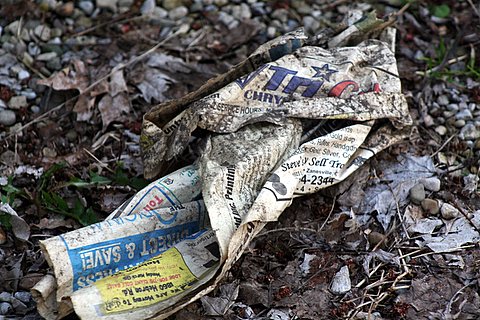
Until now everything it's OK but what catch my attention was the link between low-cost and disposability. The scientist claim that this technology would be so affordable that at the end of the day or the week you can just throw it to the garbage can. My worries are why we attached the value of and object, and in this case a really awesome product of Technic, just to its monetary value. In other words, why because is cheap it's OK to throw it to the garbage! It's not so that we cannot see value in other things other that money like functionality, convenience or even human effort (of developing such device) or the notion that maybe the intrinsic value that having something like that in our possession maybe higher that let it go to the property (and personal preoccupation and involvement free) space of the trash stream.

Cheap cannot be a synonym of disposability. Affordability cannot be a synonym of bad quality. And the garbage can cannot be the goal for technology development nor the end point of the value chain.

The report claims this technology maybe available in the market three to five years from now, we can only expect that until then our ways to see this issues change a little bit.

Image: Flickr/Kranky

Friday, 14 May 2010

Building organs block by block


Building organs block by block
Analogy can go a little bit further than a create a juicer looking like a tin-tin spaceship, and a little bit useful too.
When everybody is thinking in cell printers to do 3D tissues structures -with everybody I don't mean you, me or the next door neighbour, but the biotechnology research community- a guy came with the idea of making bricks out of cells, like legos! and then he call this technique with the awesome name of ''micromasonry''. With this new concept Javier Gomez Fernandez (who has to be someones neighbour)put in every lab the the chance to build this kind of structures without depend on advance motion control technology. Big point for creative thinking in science.

Reblog this post [with Zemanta]

Tuesday, 15 December 2009

Now we have metal that work as a tree

Recently have been unveiled a piece of metal that can transport water in a vertical way, defying the gravity force, just as trees in nature.

In Nature trees pump water up by a combined mechanism called ''the cohesion-tension theory''. Water travels up by capillarity and a difference in the water potential produced by the transpiration pull.

In Capillarity - or Wicking- the narrow the tube, the highest the column. So, if you have a extremly powerfull laser with the highest frecuency that you can imagine, a Femtosecond, what would you do? of course, the most thinnest tubes ever. That was the idea of Chunlei Guo optics scientist, from the Rochester University.

The potential aplications for this new material goes from microprocessors to clean hydrophobic surfaces...for now(when the paper that describe the process and the material is not even published yet), in the future we will hear, for sure, about more ways to apply the etched-metal.

more information on:
Reblog this post [with Zemanta]