Showing posts with label nanotechnology. Show all posts

Saturday, 7 July 2012

Stretchable light and the lost of shape


This short demo shows a prototype of a LED that can be stretch. Now, that doesn't sounds like much but think for moment in the sources of light that we have today. Since we tame electricity we've been able to make vessels that contains light. From the light bulb to the pixels that you are looking at right now all our light emitting sources have a discreet shape, its shapes are define by manufacture. Since the commercial introduction of the first light bulbs back in the 1880's the shape have been pretty much the same from the glass balloon to a ''pear'' shape (the German word for light bulb is Glühbirne which can be translated as glowing pear) then to a almost any possible variation of that.
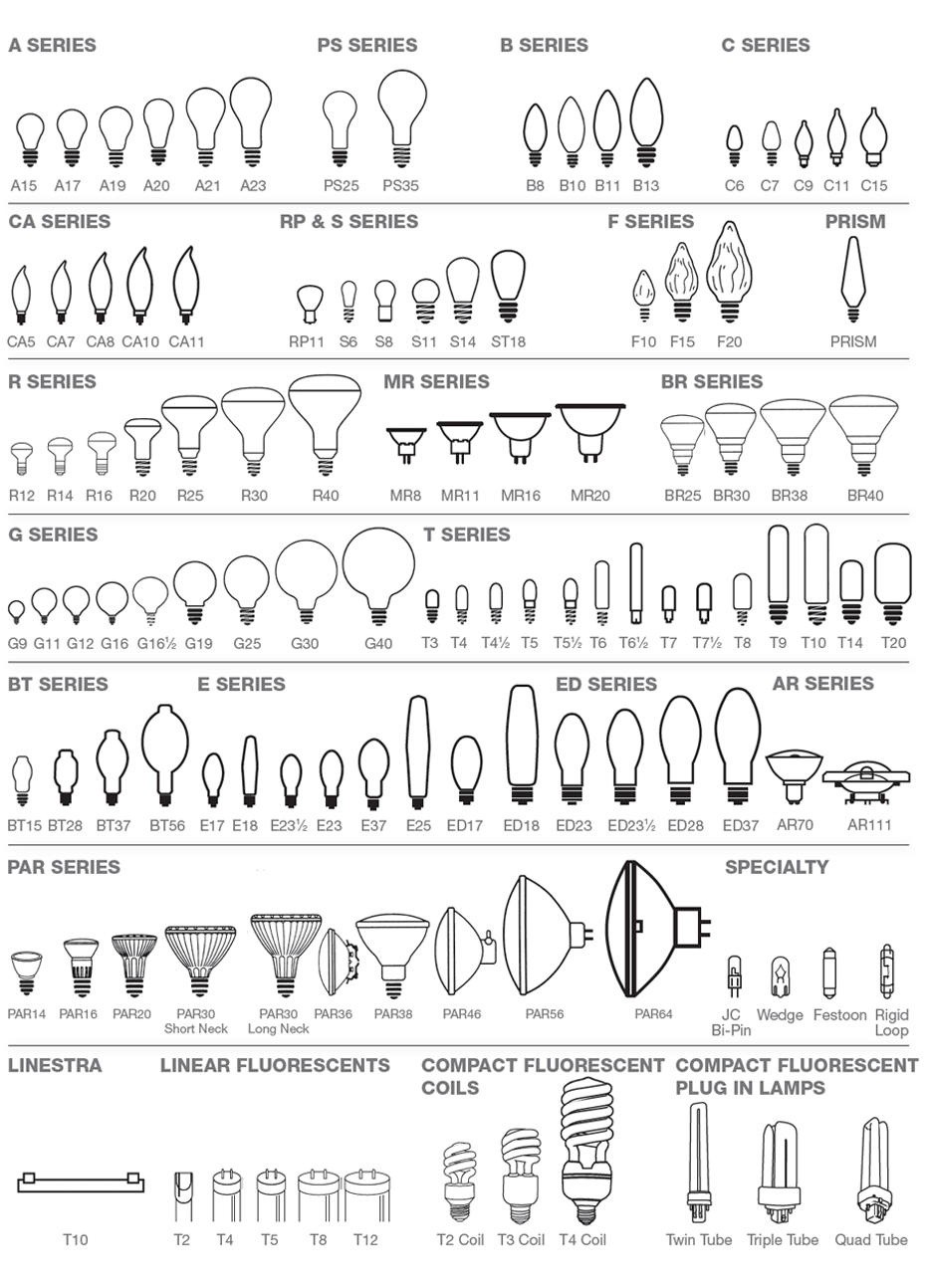
Then the fluorescent (as different as the previous incandescent) lighting technology came and also the halogen and then neon and all of them were confined either to a bulb or a tube. All of them constricted by the formal possibilities of glass. And this kept going up to the introduction in the early 60's of LED (light emitting diodes) which change the electrically powered reaction within an micro atmosphere full of specific elements ( as the Incandescence, Fluorescence, Halogen or Neon technology are) for the convenience of the electroluminescence effect in a Semiconductor, and also change the glass by epoxy. This change, the glass by epoxy, brought a whole new set of formal possibilities to the design of light sources starting for the radical decrease on size, and -for what it matters- the first squared lights.
  
But even after all these technology leaps the initial shape of the light source will be its definitive shape. The form of the light will be still the form of the mold. Until now the only source of light with the possibility of change its shape was the fire, and we couldn't control it. That change with the arrival of OLED ( organic light emitting diodes) on which the traditional semiconductor layer was replace by an organic semiconductor. The OLED technology has already proved to be flexible, which is already a great step forward. But now this little light emitting plastic sandwiched on each side by carbon nanotube-polymer can change -by being stretched- its shape, which means that its structure can be adapt in three dimensional ways. Why this is important? because of socks. Can you think in something more finely adapted to another shape than a sock wrapping you foot? a very basic shape surface that adapt to all the complexities and nuances of another intricate surface such as it is the foot.Well, when was the last time you worn a rigid sock? stretchability is the the most defining feature not for customisation, but for active adaptation. Stretchable light means that light is now is not only parts of the object but an object by itself.     

Sunday, 12 December 2010

Challenges of future design


In this video Hamilton Smith, part of the team that develop the first synthetic cell, talk with Noy Bassik about building machines in the scale of a cell. Two basic ideas are discuss in this conversation, the first one coming from Smith is to build living machines through the alteration of a already existing organism. This mean build a purpose-full device out of the essential biological parts, DNA. In the other side is the vision of Bassik that pursuit the develop of machines that interact with the chemical world of biology. What he's doing is engineer devices that can be controlled by chemical reactions fulfill a purpose. The purpose of this machines is now in the level of mechanical effects but -as they discuss- is projected to be a lot more than that, a complete factory that can sense and react producing and delivering substances needed by the organism.

Now in the eye of a Designer this may look really far away from our expertise area but there is some hints that can give us a second look. First the formal level, the technique worked by
Bassik is inspire in Origami and from this ancient art the idea of build volume out of a flat surface is drawn to research with the out coming of relevant insights to control materials through shape. This imply that formal thinking is needed in the conception of this new kind of machines and designer at above all formal thinkers. Another component of the thinking process of Design can take us into a deeper level, this is the behavioral awareness. Is well know that in Design practice the biggest tool is Observation, observation of people and their conducts, of systems and their components and relations between them, of causes and effects, actually of whatever is involved in the studied situation. This tool in combination with the problem solving thinking of engineers brings about comprehensive solutions that almost in every field of the building-things human endeavor has drive innovation. With the develop of techniques that enables to build thing in the micro scale we are entering in a new stage of technology and the products of this new phase will progressively increase in complexity, when this start to happen it will be necessary the knowledge and the thinking on how the outcome of the process of this machines will affect the whole system, in simpler words, how the behavior of this devices will cause effects on the other component of the system, as the non-micro scale devices affect us and the environment today.

Some of this worries have already take in hands of designers as in Nanotopia or in Victimless leather presented mainly as Art projects but in the way that this technologies star to permeate more deeply our cultures and our daily life the need for a technical and reflective presence of design will be more critical. So, maybe it's time to aim for the future and involve Design in the next technological revolution, design at micro scale.

Sunday, 24 October 2010

World quality innovation alliance: Fraunhofer Institute in Chile


Chile will have the first research center in South America of one of the most innovative research institutions in the world, The Fraunhofer Institut. The largest research institute in Europe is focused on transforming scientific expertise into applications of practical utility. Funded in part by public grants and mostly by privates contracts the Fraunhofer institute brings to Chile a new model of research that institutionalize the cooperation between the industry and the fundamental research institutions as the universities. The aim of this institute is to develop product starting from basic science all the way to commercial maturity, it's the link between invention and commercialization, what we can say is an innovation machine.

The research center projected in Chile will address the System Biotechnology and will work in agriculture, aquaculture and sustainable use of natural resources, boosting up big part of our raw material economy. Some of the partners in this alliance are Pontificia Universidad Católica de Valparaíso, Universidad de Talca and Fundacíon Chile; and it is cofounded by INNOVAchile.

Maybe is too much to ask but now that we have cover the agriculture and aquaculture it may be good to start thinking on address forestry and minery, and how we can jump into develop and commercialization products in this areas to give our resources more value and leave behind the raw material economy.

More information click here

Enhanced by Zemanta