Showing posts with label disruption. Show all posts

Thursday, 14 March 2013

The history of the world in 100 objects

source. The British Museum

How do we know about our past selves? About 8000 years BC we started to develop clay tokens to enumerate good. This can be said was the first gesture of the symbolic function stem out of our minds as a tool to record and manipulate the complexity of the world on which we were living. The tokens would then evolve into enumerating systems and later into what we know now as writing systems. From that point on we have what we know as history.

Writing is a tool that come from our minds and is meant to be use to shape the intangible realm of -again- the mind. But what happened with the tools we create to shape our environment or even our selves, or those object on which we project our intangible inner existence into the material world? all those stories, all those  evidences are embodied as solid reflections of our selves in different developmental stages and tainted with variant comprehensions of our meanings and perspectives.

This is the stories that a join project between the BBC and the British Museum have to tell delivered in various formats:
As Web site: http://www.britishmuseum.org/explore/a_history_of_the_world.aspx
As radio show, now as a podcast: http://www.bbc.co.uk/ahistoryoftheworld/about/british-museum-objects/
As an interactive web: http://www.bbc.co.uk/ahistoryoftheworld/explorerflash/?timeregion=7
And as a book: http://www.britishmuseumshoponline.org/invt/cmc44134/?__utma=1.432636122.1363320116.1363320116.1363322472.2&__utmb=1.5.9.1363322644495&__utmc=1&__utmx=-&__utmz=1.1363320116.1.1.utmcsr=uclue.com|utmccn=(referral)|utmcmd=referral|utmcct=/&__utmv=-&__utmk=132295566


Saturday, 7 July 2012

Stretchable light and the lost of shape


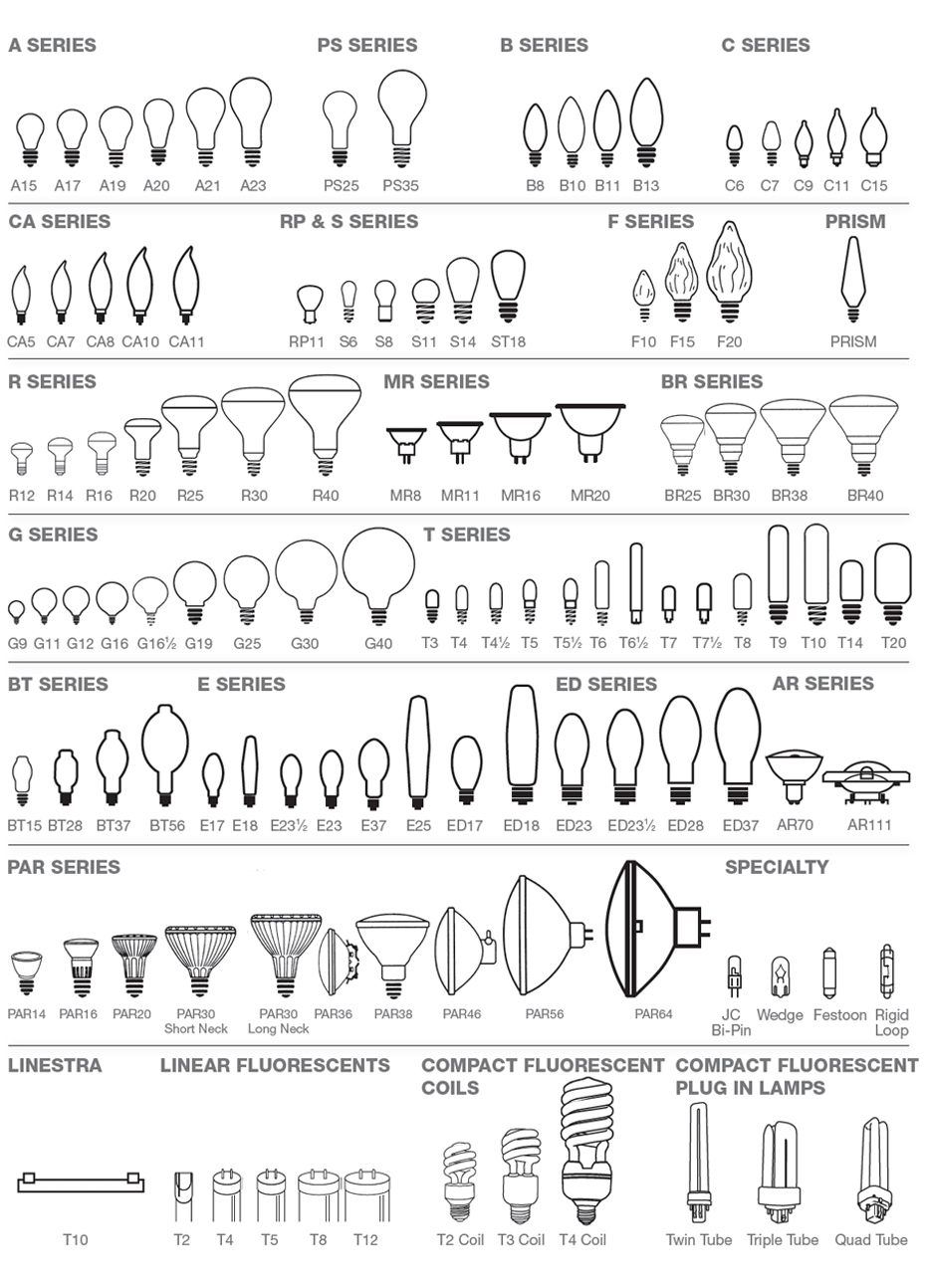
This short demo shows a prototype of a LED that can be stretch. Now, that doesn't sounds like much but think for moment in the sources of light that we have today. Since we tame electricity we've been able to make vessels that contains light. From the light bulb to the pixels that you are looking at right now all our light emitting sources have a discreet shape, its shapes are define by manufacture. Since the commercial introduction of the first light bulbs back in the 1880's the shape have been pretty much the same from the glass balloon to a ''pear'' shape (the German word for light bulb is Glühbirne which can be translated as glowing pear) then to a almost any possible variation of that.
Then the fluorescent (as different as the previous incandescent) lighting technology came and also the halogen and then neon and all of them were confined either to a bulb or a tube. All of them constricted by the formal possibilities of glass. And this kept going up to the introduction in the early 60's of LED (light emitting diodes) which change the electrically powered reaction within an micro atmosphere full of specific elements ( as the Incandescence, Fluorescence, Halogen or Neon technology are) for the convenience of the electroluminescence effect in a Semiconductor, and also change the glass by epoxy. This change, the glass by epoxy, brought a whole new set of formal possibilities to the design of light sources starting for the radical decrease on size, and -for what it matters- the first squared lights.
  
But even after all these technology leaps the initial shape of the light source will be its definitive shape. The form of the light will be still the form of the mold. Until now the only source of light with the possibility of change its shape was the fire, and we couldn't control it. That change with the arrival of OLED ( organic light emitting diodes) on which the traditional semiconductor layer was replace by an organic semiconductor. The OLED technology has already proved to be flexible, which is already a great step forward. But now this little light emitting plastic sandwiched on each side by carbon nanotube-polymer can change -by being stretched- its shape, which means that its structure can be adapt in three dimensional ways. Why this is important? because of socks. Can you think in something more finely adapted to another shape than a sock wrapping you foot? a very basic shape surface that adapt to all the complexities and nuances of another intricate surface such as it is the foot.Well, when was the last time you worn a rigid sock? stretchability is the the most defining feature not for customisation, but for active adaptation. Stretchable light means that light is now is not only parts of the object but an object by itself.     

Tuesday, 8 November 2011

The personal mobility turning point


This video is a quite interesting trip through the personal mobility history focused on describing how we found ourselves in the turning point of this industry. The arguments for this claim are the upcoming electrical technologies and material that are now being introduce in the develop of personal mobility devices, the longer performance of electrical batteries and the reduction of their sizes as well as the incorporation of high sensitive capabilities have opened broadly the spectrum of possibilities for imagining and realize new ways of interacting with the vehicles, new uses for them and, the most relevant issue, new categories of vehicles. Since the foundation of this industry both the morphology and the configuration of personal mobility vehicles has remain pretty much the same until recently devices like the SEGWAY and the Honda's U3-X (the main character of this video) have overlook the the idea that a personal vehicle has to be a car or a bike or, if you are an eccentric driver, a tricycle to bring a new category of self-balancing vehicles, and altogether opening a hole new branch in the mobility industry.

The proliferation of new devices in this area has already begun, and we can count now with transitional hybrids like one-wheeled motorcycles or Segway like devices for off road but the disruption of personal mobility it is far from being exhausted and I guess we will witness the arise of other new categories on which the power storage technology and the active sensitive capacity as well as the new ways of human vehicle interaction will have a main role.

From the Design point of view, being involved in this turning point means a bit more than just to make these new devices more aesthetically appealing or user friendly; it means also to imagine, research and prototype new ways to communicate the human will to an electromechanical device so the relationship between them can become more intuitive and responsive.

That's it for now, by the way, this video is produced by Gizmag and you can read the hole article here.
Enjoy