Sunday, 5 May 2013

BABYBE goes to MIT!!


BABYBE project was chosen between the three finalist of Aji Challenge to pitch the project in the MIT in front of a jury of experts!!!
This will take place in the frame of Encuentros2013, the largest gathering of Chilean students, researcher, professionals and entrepreneurs abroad, which will be held from 27th to 30th of June at the MIT Media Lab in Boston.  

3D portraits from random DNA samples

Heather Dewey-Hagborg
Something you may not be aware is that you are leaving a DNA footprint behind every chewing-gum you throw away in the street. And something you may not even imagine is that there someone that can pick it up, go to a DIY biology lab, amplify the DNA sample through PCR (polymerase chain reaction)  to study the SNPs (Single Nucleotide Polymorphism) and trace in this way genetic traits like, gender, eye color, hair color, ancestry and so. But that´s not the end of the story, after an Allele profile has been define a computer software builds a 3D model of THE FACE! of the individual whose DNA was found in the chewing-gum and after some "finishing touches" the 3D model is printed and hang in a wall (some will say like a hunting trophy) of an Art Gallery. Yes, this is an Art project still. Heather Dewey-Hagborg is the responsible for this amazing journey from Science to Art. Her work can be seen in some galleries now and of course in her website and in her Blog.

Via: thisiscolossal
 

Thursday, 2 May 2013

A boy and his Atom, The world´s smallest movie!!! (dancing atoms)


Ok, This is something we were not waiting for. Usually in technology you can predict with certain accuracy where things are going, either smaller or integrated in most cases. But this time foreseeing a stop motion movie made by moving single atoms around would have been a prove of prophetic talents, and this is not only because it´s a movie recorded with a 100 million times magnifier glass but because there are atoms telling the story of a kind falling in love with one of them, playing, jumping and laughing together. Of course the implications of this technology go far beyond the realm of filmmaking  straight to the data storage industry, promising that in a not so far future we would be able to storage all the movies ever made in one single smartphone.  Now think about this, what a better way to start that story, the story on which knowing something like the back of my hand will mean to know all the information ever produce by man, that with a love story between a young, curious and open mind and the single piece of matter that  builds that mind. That´s is just Poetic.
Cheers on IBM research for this one!!!

To see the making of  click here

Sunday, 14 April 2013

3D Printed guns


A short documentary from VICE about the home based manufacturing of guns through 3D printing processes.

Guns, some will say, are tools and you cannot criticise or regulate the ownership of the tool by the potencial evil use of it. This is quite true in most cases but the reality is guns are tools ment to be use on evil ways, guns are either for killing something or for get control over a subject by threading to kill or injure it.  Criminals do that as well as the Police.

Now with the digital manufacturing revolution getting into every home and supported by 3D files sharing communities we can not only print guns but we also can share with the  world specialised knowledge about building guns, so everyone having a 3D printer can become a potencial gun man to defend his own couse, this being criminal life or a fighting an oppressive ruler.

As with every mayor technological revolution on manufacturing the bottom line quickly becomes about power and dominance either from one country to another or from one side of society to the other, but differently from previous breakthroughs this one place the responsibility to answer the question about how to use this new possibilities directly on the hands of the one used to know as the bystander.  


Via VICE

Wednesday, 3 April 2013

low cost cooling device for neonatal care


When babies are deprived of oxygen before birth, brain damage and disorders such as cerebral palsy can occur. A common cause of this deficiency is knotting of the umbilical cord, and in developing nations, untrained delivery, anemia, and malnutrition during pregnancy can also contribute to oxygen deprivation. Extended cooling can prevent brain injuries, but this treatment is not always available in developing regions where advanced medical care is scare. Johns Hopkins University undergraduates have devised a low-tech $40 unit to provide protective cooling in the absence of equipment that can cost $12,000. The device, called the Cooling Cure, lowers a newborn's temperature by about 6 degrees F for three days - a treatment that has been shown to protect the child from brain damage if administered shortly after a loss of oxygen has occurred. The device, simply made of a clay pot, plastic-lined basket, sand, instant cold pack powder, and a temperature sensor, is powered by two AA batteries.

repost via: tech briefs tv

Monday, 18 March 2013

Products through the ages - slideshow


3 1/2 minutes, 12 objects, one example for every decade between 1900 and 2010. Newspaper, telephone, pram, one pound, hearing aid, mannequin, milk container, music format, swimsuit, keyboard, jelly mould and alarm clock.

Friday, 15 March 2013

Micro manufacturing robots as a children´s book


Pop-up books are always a fascinating way of making narratives more appealing to children and delight craft-sensitive grown ups with unexpected volumes being unfolded in every turn of the page, but building functional complex robots through this process sounded -at least- far fetched.
This is how bees are born today... Well, just mechanical ones, for now.  Harvard Researchers have develop a process on which a a robot bee, its assembly scaffolding and its support are fabricated as a Printed Circuit MEMS (Micro Electro Mechanical System) stacking  a group of 18 previously laser cut layers of different materials. In the cut, stacking and organization of these layers lays a surprising secret that rivalry the magic of  Alice in wonderland. (check the video to discover it)
Utterly amazing fabrication and assembly process that, although its complexity, looks simple as a children´s book.

Via: scientificamerican

Thursday, 14 March 2013

The history of the world in 100 objects

source. The British Museum

How do we know about our past selves? About 8000 years BC we started to develop clay tokens to enumerate good. This can be said was the first gesture of the symbolic function stem out of our minds as a tool to record and manipulate the complexity of the world on which we were living. The tokens would then evolve into enumerating systems and later into what we know now as writing systems. From that point on we have what we know as history.

Writing is a tool that come from our minds and is meant to be use to shape the intangible realm of -again- the mind. But what happened with the tools we create to shape our environment or even our selves, or those object on which we project our intangible inner existence into the material world? all those stories, all those  evidences are embodied as solid reflections of our selves in different developmental stages and tainted with variant comprehensions of our meanings and perspectives.

This is the stories that a join project between the BBC and the British Museum have to tell delivered in various formats:
As Web site: http://www.britishmuseum.org/explore/a_history_of_the_world.aspx
As radio show, now as a podcast: http://www.bbc.co.uk/ahistoryoftheworld/about/british-museum-objects/
As an interactive web: http://www.bbc.co.uk/ahistoryoftheworld/explorerflash/?timeregion=7
And as a book: http://www.britishmuseumshoponline.org/invt/cmc44134/?__utma=1.432636122.1363320116.1363320116.1363322472.2&__utmb=1.5.9.1363322644495&__utmc=1&__utmx=-&__utmz=1.1363320116.1.1.utmcsr=uclue.com|utmccn=(referral)|utmcmd=referral|utmcct=/&__utmv=-&__utmk=132295566


Sunday, 24 February 2013

 "Reason is the organ of truth, but imagination is the organ of meaning."

C.S.Lewis

Mechanical beauty


because beauty also matters...
via: gearpatrol

Sunday, 13 January 2013

The real sound of wood

Today looking for input for a new project related to musical instruments i found what i think is a big leap forward to give musicians in the search for a personal sound an alternative to electronics. This a MIT student that device a way to sense the specific oscillations of the wood of the guitar. So, if you change the soundboard of the guitar (as you do with the chameleon guitar) you change the sound of it. As an extra, the soundboard becomes a platform for experimentation with different materials like water, oil or whatever you want to put inside the special container under a modified soundboard.

via: http://buildingtheergonomicguitar.com/2009/03/mit-chameleon-guitar.html

Thursday, 27 September 2012

Smart mechanics

Nowadays the Word ''Smart'', regarding products, is associated to devices enhanced by electronics in sensitive and responsive ways. It refers to the technology that drive inanimate objects into a more sentient stage of their development. But electronics is not the only way to reach that goal. Through the intelligent use of mechanics it can also be achieve the point on which inanimated objects would recognize key features of their users, helping them with this to perform better whatever task these objects are meant to do.

This is the case of the Cannondale concept bike developed by Priority Design. The C.E.R.V (continuosly ergonomic race Vehicle) adapt its handle bar position to match the most efficient posture for different kind of terrain. Without a doubt a great example of meaningful collaboration between design and engineering.


Find more about the CERV bike here

Saturday, 15 September 2012

keeping a diary makes you creative


In this talk Teresa Amabile, author of the excellent book: Creativity in context, present her studies on how keeping a diary help to improve your inner work life. What she actually says -and I guess she also writes in her last book: The progress principle- is that giving your self 15 minutes a day to write about the emotions and motivations that you experience during the day (which is the meaning of inner working life) can help you to improve your creative performance, that is, having ideas that work.

The benefits of keeping a work diary would be first of all, celebrate small wins, which is actually the cornerstone of what she named ''the progress principle''. State and recognize small wins will keep your motivation up, your emotions on the bright side and your perspective focus on the relevant aspects of the work that you are doing. The second benefit will be that, based on that small wins, you will be able to plan the next steps in order to keep that small wins coming and building up a better and more fulfilling way to the completion of the project you're working on. The third benefit will be within the personal area; keeping a diary will help you to visualize and nurture your personal growth. You will be able to see in clearer way for example how you behave with you team mates and colleagues, what makes the teams interact in more efficient and creative ways or what are the consequences of your decision process. The last benefit that Amabile states may sound kind of irrelevant but anyone who has worked in a long term project will recognize the importance of it: cultivate patience. One of the most definitive factors in the success of every project  is the emotional attitude to it. If is negative the project will suffer enormously of disdain and lack of interest and if it is positive usually the anticipation and the anxiety of make the whole thing work will play against the decision making process pushing forwards steps that are not yet mature enough to lead way to the next ones.

Amabile is surely one of the most relevant figures in the study of creativity. Her systematic psychological studies on how creativity affects the life of individuals and organizations is widely recognize as huge source of insights in the understanding, improvement and management of creativity processes.

Teresa Amabile is the Edsel Bryant Ford Professor of Business Administration and a Director of Research at Harvard Business School and lately the ranked number 18 on the Thinkers 50, the definitive listing of the world's top 50 business thinkers.

source: 99U.com

Monday, 16 July 2012

Innovation Award to Amazen' Hat Commander video game

Last Weekend in Stuttgart took place the first GAMEDEV HACKATHON, a competition about making a computer game within two days. Me and Raphael Lang attend and in the place we team up with Guz Gutmann from ambient robotics. The game we develop for this competition explores new ways of interaction, giving the players not only the chance to control the character (which in our case was a little red spherical starship) but also the environment on which the action take place. The goal of the game is go from one end of a linear maze to the other. Pretty simple isn't it, well the things get trickier when that line is magnified 100x by a microscope and shown in a TV, then the picture is recorded by a web cam and processed by Grasshopper which renders it now in a Rhino environment as a tridimentional landscape. The Hat, by another hand, controls the little red spherical starship through bending its vertical antenna. The antenna consist in a flex sensor which signal es processed by Arduino and sent to the PC, where the serial output is taken by Grasshopper to control the left or right direction of the starship.    


Unexpectedly, we receive the award for the Most Innovative Game Concept. Among the judges appreciation were statements like: 
"When I enter the room it this weird stuff call immediately my attention, so i had to go and check what it was"
" It looks fucking awesome!!"
" I could play it for hours"


Now i leave this demo video so you can check what is it about.


you can also check the event facebook:http://www.facebook.com/HackathonStg
or Website at:http://www.hackathon-stuttgart.de/


Saturday, 7 July 2012

Stretchable light and the lost of shape


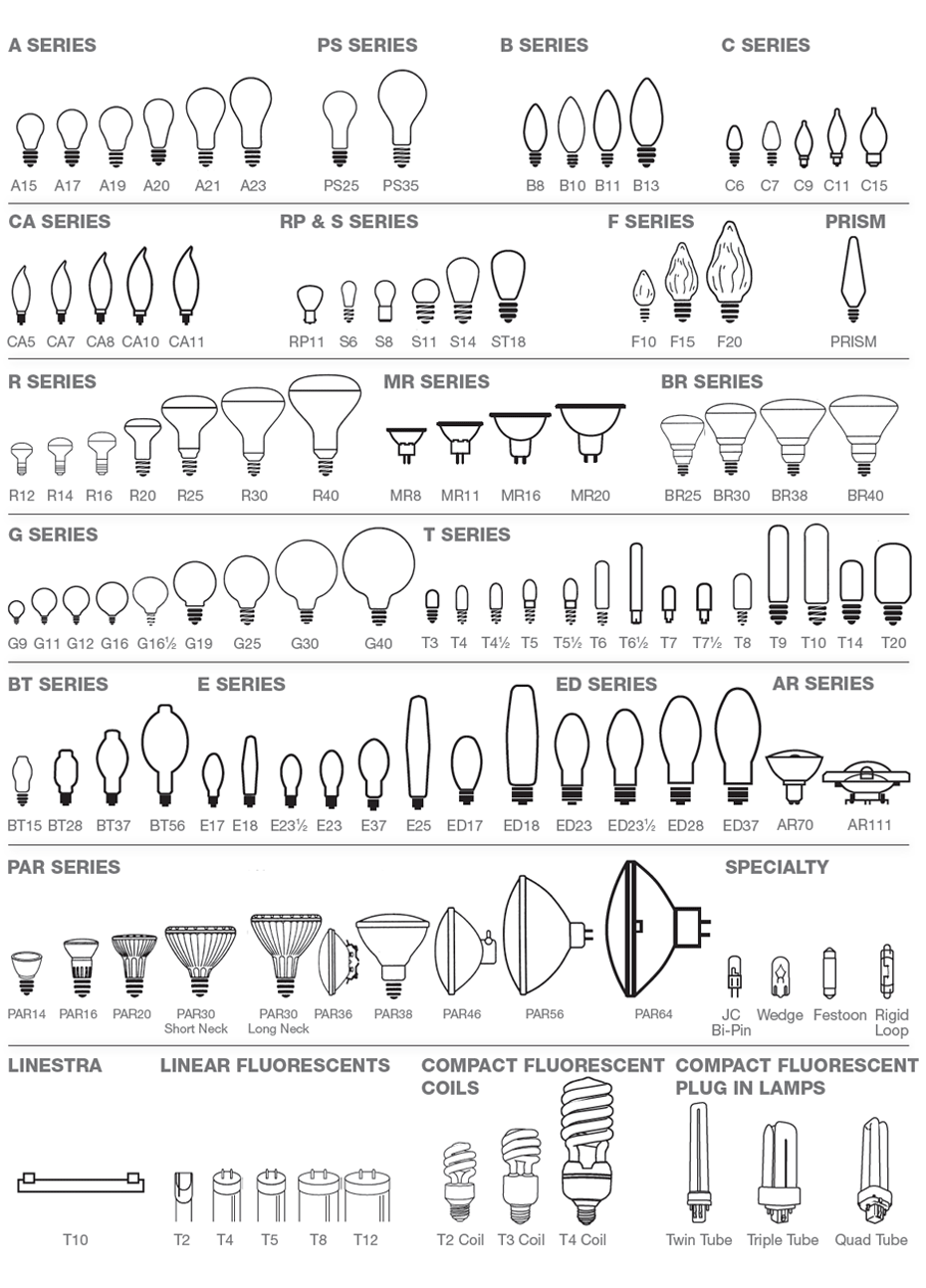
This short demo shows a prototype of a LED that can be stretch. Now, that doesn't sounds like much but think for moment in the sources of light that we have today. Since we tame electricity we've been able to make vessels that contains light. From the light bulb to the pixels that you are looking at right now all our light emitting sources have a discreet shape, its shapes are define by manufacture. Since the commercial introduction of the first light bulbs back in the 1880's the shape have been pretty much the same from the glass balloon to a ''pear'' shape (the German word for light bulb is Glühbirne which can be translated as glowing pear) then to a almost any possible variation of that.
Then the fluorescent (as different as the previous incandescent) lighting technology came and also the halogen and then neon and all of them were confined either to a bulb or a tube. All of them constricted by the formal possibilities of glass. And this kept going up to the introduction in the early 60's of LED (light emitting diodes) which change the electrically powered reaction within an micro atmosphere full of specific elements ( as the Incandescence, Fluorescence, Halogen or Neon technology are) for the convenience of the electroluminescence effect in a Semiconductor, and also change the glass by epoxy. This change, the glass by epoxy, brought a whole new set of formal possibilities to the design of light sources starting for the radical decrease on size, and -for what it matters- the first squared lights.
  
But even after all these technology leaps the initial shape of the light source will be its definitive shape. The form of the light will be still the form of the mold. Until now the only source of light with the possibility of change its shape was the fire, and we couldn't control it. That change with the arrival of OLED ( organic light emitting diodes) on which the traditional semiconductor layer was replace by an organic semiconductor. The OLED technology has already proved to be flexible, which is already a great step forward. But now this little light emitting plastic sandwiched on each side by carbon nanotube-polymer can change -by being stretched- its shape, which means that its structure can be adapt in three dimensional ways. Why this is important? because of socks. Can you think in something more finely adapted to another shape than a sock wrapping you foot? a very basic shape surface that adapt to all the complexities and nuances of another intricate surface such as it is the foot.Well, when was the last time you worn a rigid sock? stretchability is the the most defining feature not for customisation, but for active adaptation. Stretchable light means that light is now is not only parts of the object but an object by itself.     

Wednesday, 4 July 2012

Norddesign paper approved

These are good news, I will be presenting my paper: Emotional prosthetics: Artificialy replace physical manifestations of emotions with the purpose of enhance the Mother-Son multisensory bond inside the intensive care environment. Next August (22-24) in the Norddesign conference in Aalborg University in Denmark. Here I left you the the abstract.

Collecting the mother’s emotional physical manifestations (EPM) and replicate those into the incubator machine environment can help preterm baby’s self regulation. Here’s presented a method to assess mother-child emotional care situations and  extract the right stimuli (EPM) from them that could  produce in the baby a emotional response that help him to improve his health condition as well as a mediation interface that harvest the stimuli from the mother and deliver it to the baby
 

Tuesday, 27 March 2012

what comes first: the innovation or the change

Today I just wanna to share convergence rather fun/weird that happens me today. I'm now reading a book call "the rational optimist" by Matt Ridley, who is talking about how ideas and innovation is the motor behind the progress of humanity and how the exchange is the fuel for this to happen, when I came across with the column from Johan Lehrer in Wired magazine which is talking in this post (http://www.wired.com/wiredscience/2012/03/cultivating-genius/) about how throughout history geniuses had cluster in specific times and places. He bring the notion of meta-ideas, propose by Paul Romer, to solve the riddle of why this clustering -or clotting how he calls it- happens. By another hand Ridley go through the same issue discarding: government, intellectual property (a meta-idea propose by Romer), capital and science, only to set the "clotting agent" on the exchange. Information exchange. Were there is ideas being exchanged -or having sex as he stated- innovation, hence innovators, will happen.
Both authors state that innovation is needed urgently nowadays -to reactivate the economy, dodge the environmental collapse, fight the totalitarianism or corporatism or anarchism, or just change the world for better in some way- but even when they don't really agree in the essential factor, or factors, which detonates the appearance of innovation, the same question remains in the backstage of both arguments: to make a better societies -or world for what matter- we need more innovation; but for having more innovation, isn't that we need first to change ours societies?

Tuesday, 8 November 2011

The personal mobility turning point


This video is a quite interesting trip through the personal mobility history focused on describing how we found ourselves in the turning point of this industry. The arguments for this claim are the upcoming electrical technologies and material that are now being introduce in the develop of personal mobility devices, the longer performance of electrical batteries and the reduction of their sizes as well as the incorporation of high sensitive capabilities have opened broadly the spectrum of possibilities for imagining and realize new ways of interacting with the vehicles, new uses for them and, the most relevant issue, new categories of vehicles. Since the foundation of this industry both the morphology and the configuration of personal mobility vehicles has remain pretty much the same until recently devices like the SEGWAY and the Honda's U3-X (the main character of this video) have overlook the the idea that a personal vehicle has to be a car or a bike or, if you are an eccentric driver, a tricycle to bring a new category of self-balancing vehicles, and altogether opening a hole new branch in the mobility industry.

The proliferation of new devices in this area has already begun, and we can count now with transitional hybrids like one-wheeled motorcycles or Segway like devices for off road but the disruption of personal mobility it is far from being exhausted and I guess we will witness the arise of other new categories on which the power storage technology and the active sensitive capacity as well as the new ways of human vehicle interaction will have a main role.

From the Design point of view, being involved in this turning point means a bit more than just to make these new devices more aesthetically appealing or user friendly; it means also to imagine, research and prototype new ways to communicate the human will to an electromechanical device so the relationship between them can become more intuitive and responsive.

That's it for now, by the way, this video is produced by Gizmag and you can read the hole article here.
Enjoy

Tuesday, 11 October 2011

Work vs. Play

Yet another talk about how IDEO work. This time related to the value of Play at work, with good examples of how a relaxed but focused environment where failure is tolerated can drive design teams to a successful delivery of solutions in complex situations.